Welcome To My ENG 101 Portfolio
Purpose Analysis
Every advertisement has a purpose so that the company sends a clear message making the most out of their advertising costs. In Mitsubishi’s advertisement in 2015, shown above, the company portrayed the body of the car as a rhinoceros with wheels. The advertisement displays the body of the car directly above the rhino with some writing on the top left side. The whole advertisement is set in neutral brown coloring. The purpose of the advertisement is to compare this Mitsubishi car to a rhino, implying that it is a tough, strong car that will last long. People generally want durable cars, so this image displays the Mitsubishi Pajero car as such in order to make it more desirable. Particular strategies work to support or achieve a purpose like this in advertisement situations.
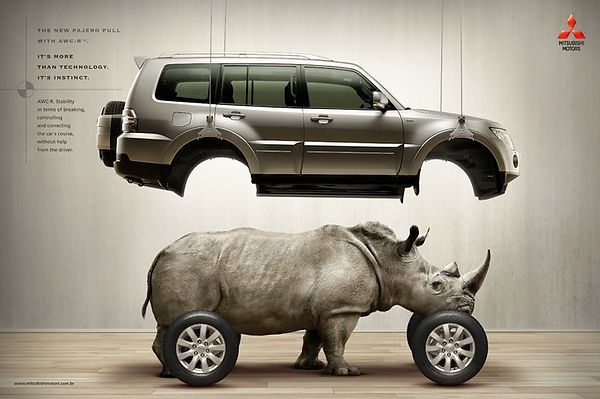
Mitsubishi Pajero car advertisement made in 2015.
The main reason this advertisement appeals to many people is because it uses the image of the rhinoceros. People love seeing animals! Displaying an animal on this advertisement evokes pathos in the people who see it. For example, I chose this advertisement because it has a beautiful rhino in the photo. The advertisement spoke to me because I am a soft hearted person who loves animals. The same, portraying animals to draw in the hearts of viewers, works in regards to advertising and why this rhino is presented in the photo. Next, the color scheme of the image is mostly all neutral shades of brown or grey. The image is displayed in uniform and therefore encourages the viewer to take a second glance at what is actually happening. The viewer of the advertisement will then investigate the image closer to see the shiny car and the rhino, and will be inclined to read the words to discover what the image means. The art of this advertisement is displayed to attract viewers and convince them to buy their cars. The third strategy that works toward selling the car in the advertisement is the statistic written on the left side of the image. The photo states “AWC-R stability in terms of breaking, controlling, and correcting the car’s course, without help from the driver.” Stating facts and statistics is a great way to appeal to someone’s sense of logos and get readers and viewers interested. After reading this statement, people want to know more and become interested. For example, I was really interested in the fact that the car can correct itself and adjust without my help. This is a good technological benefit to driving because it keeps people safe while driving! Safety is something most people appreciate in a vehicle. Another great point of this advertisement was to write the fact in a smaller font. This requires the viewer to take a closer look in order to read it and therefore examine the advertisement even more.
These strategies are all successful to attract many people to buy the Mitsubishi automobile, but the one that stood out to me was the logos aspect of the advertisement. Stating facts and statistics always gets my attention. Logos does not always work when it comes to articles and the news media, but it is usually more effective for product advertising. When articles and news media use logos, the photo marketers simply want readers hooked on the images as well as the product. In regards to product advertising, companies typically only incorporate facts about the product that would benefit their advertising most. Stating facts or statistics about the product give it credibility in the mind of the viewer. In this Mitsubishi advertising image, using the statistic of the cars’ ability to keep people safe speaks to why people purchase a car in the first place. Cars are used to get from point A to point B. When I am looking to buy a car, the first thing I look for is reliance and safety. The advertisement addresses these requirements right away and encourages the viewers of the car’s desirability. This is why the advertisement is so successful in selling cars! Perhaps if I was more interested in how the car looks or feels, I may not find this car appealing after seeing this advertisement. It does not address the style or the comfort of the car, but I believe that most people care more about safety than style.
All of these strategies work really well to attract car buying customers. However, I would suggest expanding on the point of the car’s style and comfort. Perhaps in the bottom right and left corners where there is blank space, the designers could add a little sneak peak to the comfort and style of the vehicle. This would cover all the bases without telling the customer every detail of the car. I think it’s important to leave a little mystery to the vehicle so that the customer has to do their own research and perhaps even go to the dealership to look at the car. The strategies in advertising are all very successful and require a lot of thought. This is why we have people that go to school specifically for marketing. So, in conclusion, I would give this advertisement a good grade because of the many details in the advertisement but as we can see, it could include some other points to be more inclusive.
The purpose of the advertisement is to get people to draw attention to the Mitsubishi brand, so it is important to address the actual audience that is going to be buying this car. The audience invoked are people looking for their next vehicle. I think the Mitsubishi advertisement was successful in using logos and pathos to attract customers. The best advertising strategy in my opinion was using logos by stating a fact about the vehicle in the image because it not only builds credibility but also reinforces why someone should purchase Mitsubishi cars now or in the future. Deciphering the audience and message of an advertisement is paramount in determining the success of the creator.
Works Cited
Mitsubishi. “Rhino Metaphor.” Imagination Is Magic, Wordpress, Mar. 2015, jayinniss.files.wordpress.com/2015/03/rhino-metaphor.jpg.